

In another life, The Naked Sun frontman Drew Harris is a prolific author.
It’s not just because of his background in education (more specifically, English), nor is it simply his appreciation and consumption of all things literature, but I’d make the case based solely on his approach to songwriting. He’s a lyrics man. And in that crafting of syntax, he seeks to implement a narrative of specific, deliberate, poetic word choices. How the listener chooses to interpret is up to them… but no syllable is placed by accident.
Whether drawn from the poetic storytelling of Bob Dylan, the emotionally-tinged Americana of Tom Petty, or the observational ambiguity of Kurt Cobain, Harris cites a wide spectrum of legendary songwriters as masters of his craft and influential figures in his own life.
When asked how he hears a new song for the first time, and whether or not it's the guitars, the melody, or what, he responded without an inkling of hesitation:
“It’s always lyrics first for me,” says Harris. “You have an opportunity to say something, so just try to fucking say something!”
In the vein of what Harris considers to be a peak contemporary example of the type of songwriting he strives for, he cites Hooray for the Riff Raff’s The Past is Still Alive. “The way she writes about these characters has so much empathy for the character, as flawed as they are, and I feel like I’m there, you know? Like, ‘I know this person.’”
And it's in this specific and unique approach to crafting his songs that you can begin to unravel the layers of what makes The Naked Sun distinctly themselves: a committed combination of passion, authenticity, and care. Harris’ lyrical content and themes come from deeply-rooted personal places. Yet even tracks that are an inspired result of lived experience do not rob the listener of the ability to make up their own mind. He wants listeners to ask themselves, “What did you get out of it?”
One thing that’s beyond a doubt is that Drew Harris very much cares. He seeks to connect with his audience with sincerity, even when the content might not be overtly spelled out for listeners. There is always an opportunity to find the connection through our universal language of feeling–and Harris feels deeply. So it's no surprise that the definition of mega-rock-star success has taken a different shape for Harris and company.
“I think success for me and my bandmates has really come from a deeper, personal level of identity,” notes Harris. “Who we are, why we do this–it’s so different being in a band when you're 43 than being in a band when you’re 22.”
While Harris’ current life errs more towards stability than the reckless abandon of youth, he’s certainly found success from a community-oriented standpoint. The Naked Sun has been regularly performing for years, gaining new fans along their musical journey. It’s not hard for talent to attract talent, especially in a musical landscape as saturated as Philadelphia.
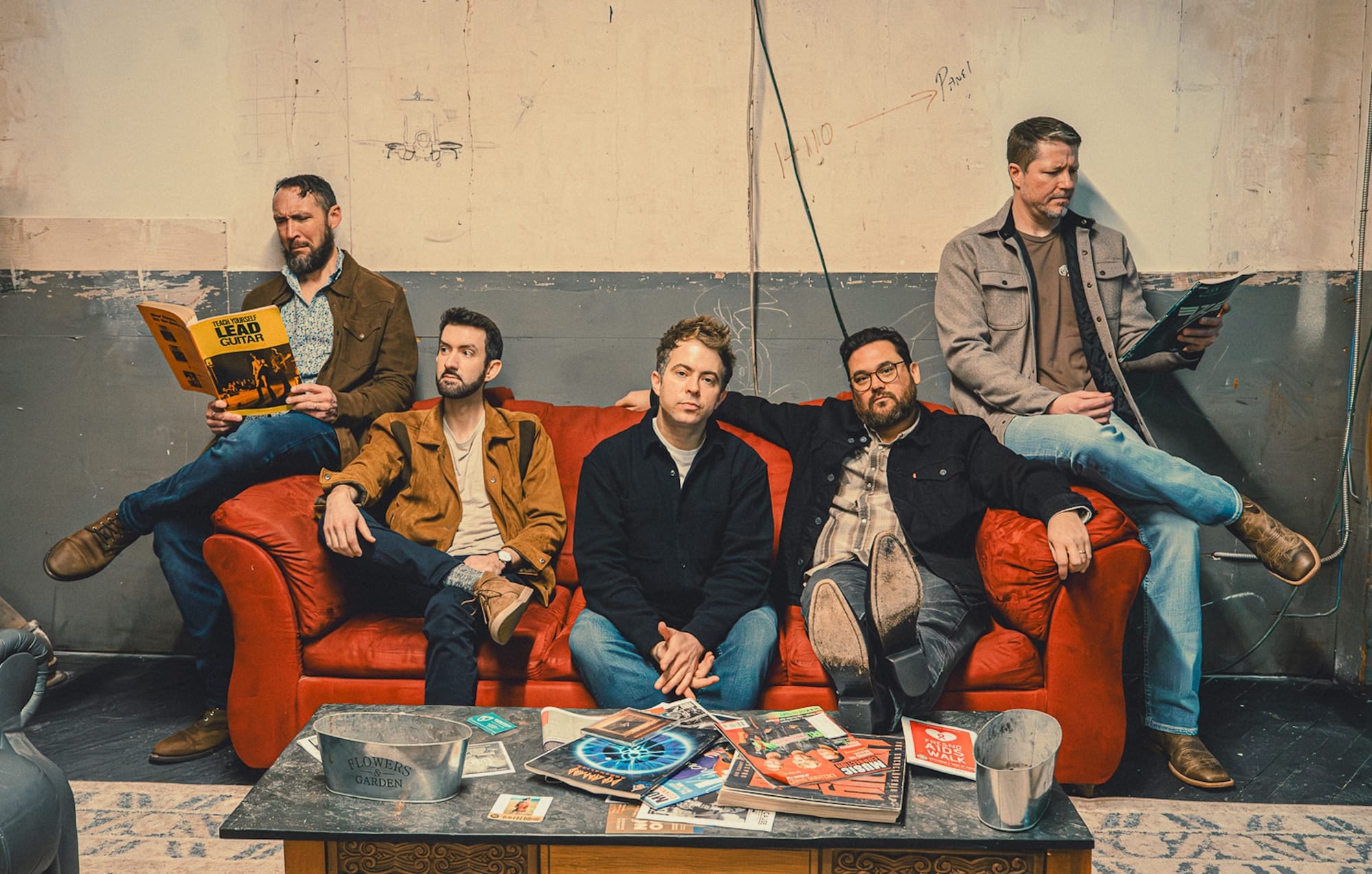
Drew Harris is a musician’s musician. He’s his own harshest critic and exceptionally dialed into the nuances of both songwriting and recording. To him, there is little room for error. The type of things to go unnoticed by the layman are the types of things that could seemingly keep him up at night. And this is not some form of neurosis or hyperfixation. By my best estimate, he’s a pretty relaxed guy; easy to talk to and clearly happy to be making and performing the music he loves... Instead, his tendency to critique seems to be borne of his need to express his artistry with the highest level of authenticity and sincerity. If there’s one major takeaway from my talk with Harris, I’d say the most earnest and sincerely expressed ideal was in just how much this all means to him.
From gratitude to artistic craving, his commitment to The Naked Sun is his life’s greatest pursuit, not simply some weekend side-gig with friends. And that sentiment carries over to his approach in releasing his work, noting that he seeks to release fully-realized albums rather than the modern day streaming-based method of endless singles.
When asked how he tackles this very modern-day musician problem of singles as a means of promotion versus full-length LPs, Harris says. “I’m always wondering as a business - or as much as a business-minded person as I am or can be. The artist in me is like, ‘you make albums,’” says Harris. “That’s what I grew up with. Albums are like books. They’re works of art, they’re cohesive. They’re deep. They’re meaningful. I can sit with one for a long time. I can tell you my favorite records. I could tell you what I was doing when I first heard them.”
And it’s with this sentimental and artistry-driven outlook that Harris will always strive to actualize his vision over making a quick buck. It’s a hill he climbs regularly, noting that even their latest release, January’s Mirror in the Hallway, was a feat in and of itself in getting it across the finish line. “Getting this record out was a mini-miracle,” reflects Harris.
Yet none of this is to say he’s joyless in his artistry. In fact, I’d say his approach is exactly the opposite: to Harris, music is one of the universal essentials to living a good life. It’s as critical as the air we breathe or the water we drink. It acts as a great unifier of people. And he sees how the joy brought to him in being a musician can be spread to the people of Philly and beyond, the same way his own heroes brought him joy through the years.
And it's in that strength of community that can be found in any city or town with strong musical roots that Harris has found home here. On the strength of Philly’s local scene specifically, Harris notes, “I could think of ten bands tonight that if I could be in five places at once, I would go see.”
Since age five, Harris has been performing. Originally from New Jersey, he first got his musical toes wet in the Baltimore scene with exposure to a vast array of genre-diverse artists. “A girl and a job led me to Baltimore,” Harris explains, sharing the outset of his musical journey. “Lost the girl, kept the job.”
It was there that the young twenty-something version of Harris started to take part in the local music community. “It was such a funky, cool music town. There was a ton of basement shows, crust-punk houses - The Copycat Building, so there was a ton of warehouse spaces. We had Future Islands, Wye Oak, Dan Deacon; I saw Diplo and MIA once just, like, hanging out. It's very accessible. That DIY ethos that I learned from punk rock really just translated into that world of creating the scene.”
Harris’ immersion in Baltimore served as both a learning experience and spark of inspiration. His time there, and exposure to such musical diversity, served to be the catalyst that lit his own musical fire. Eventually, the winds of fate brought him back to Philadelphia where he was determined to take that leap of faith every artist must face in their career and simply go all in. “When I moved to Philly, I was like, ‘I’m doing music. I’m putting all my energy and all my efforts into music.’”
And in that commitment, The Naked Sun came to fruition. Initially started on his own, the addition of personnel to complement and help fully realize his vision came swiftly. After a series of strange encounters via Craigslist want-ads almost derailed his hopes of ever finding anyone serious (and not creepy), he found guitarist Tim Campbell. The two clicked seamlessly.
“When I went over to Tim’s house, I was so wary,” notes Harris. His first two Craigslist experiences didn’t instill much confidence after it was revealed they were not, in fact, musicians and instead had ulterior motives. Harris refers to the experiences as: “dates I didn’t know were dates.” Fortunately, Campbell proved to be the real deal. “When [Tim] picked up a guitar and started playing along to my song, I was like, ‘OK, cool.’”
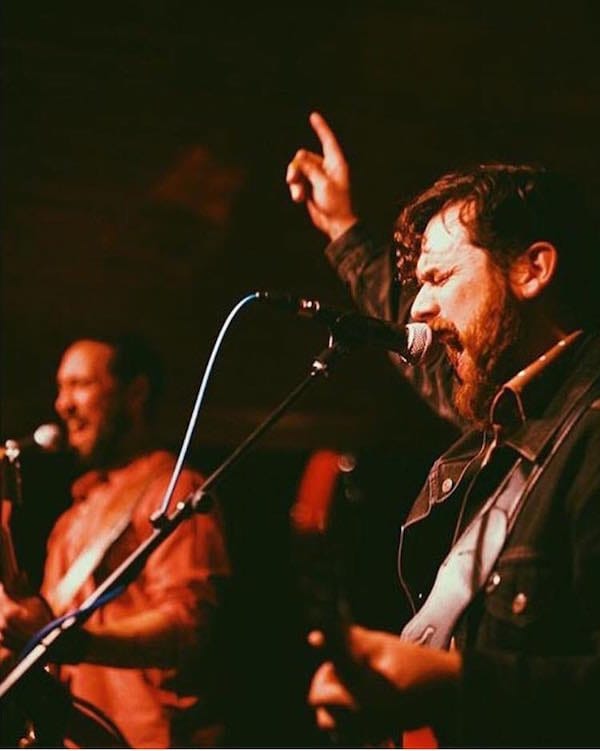
From that point, the project had legs. Branded on a whim by Harris as “honest-rock,” the band began to coalesce into what you hear today. Often regarded alongside acts like The War on Drugs and hometown hero Kurt Vile, The Naked Sun fits comfortably within the indie/alt-rock scene from which they draw clear influence and they’ve become a nestled-in local staple. But Harris’ encyclopedia of inspiration is not limited to any singular genre lane. He cites his favorite artist as Canadian punk band Propagandhi, and, while both Kurts, Cobain and Vile, have their place, Kurt Cobain is cited as the reason he picked up a guitar in the first place.
“I found Nevermind, I think when I was in third grade. One of the older kids had it–it was on a cassette tape. He was playing it after school in a classroom and we were all in our Catholic school uniforms, like, ‘we probably shouldn’t be listening to this right now, and if an adult walks through that door, we’re hitting stop...’” He continues, “Just huddled around listening to all those songs, I was like what the fuck, man… and then my uncle, who is very cool - great music taste - bought me the Unplugged CD. After that, I was just obsessed. I was like, ‘I need a guitar in my hands. Right now.’”
While the sentiments explored in The Naked Sun’s musical output come out in a cohesive, mostly genre-definable manner, the spectrum of influences and inspiration remains multi-faceted. Within that array of influence, Harris is able to work in countless nods to everything from mythological literary references to psychedelic odysseys to punk rock expressionism.
At the end of the day, what artists like The Naked Sun, and songwriters like Drew Harris represent is the purity of the craft of untethered musical creation and the profound effect it has on people. Art expressed as truth rather than a product is infinitely more powerful and important.
On mainstream success achieved by his contemporaries, Harris notes, “When I see the Philly bands that come out of our scene, or tangentially to our scene… bands like The War on Drugs or Kurt Vile, folks like that, they’re not changing anything that got them there. I would be hard-pressed to find anyone I consider to be an authentic Philly artist and be like, ‘oh, no, they changed to get that.’ I don’t think that’s who we are… it really does seem to me that our identity is our identity. It’s who we are.” He continues, “There’s this undercurrent, this theme of individual expression, authenticity, a real kind of ethos that’s like, ‘that’s what’s most important.’”
From the community level in the streets, bars, and venues of Philadelphia, to the national zeitgeist of contradiction that comprises this country’s soul, to the world and music as a universal language, there is no question about Harris’ appreciation for the art of music as creator, purveyor, and consumer. It’s his love, care, and passion that so clearly feeds his need to create and share his own vision of it. And while the summit may appear near or far depending on the day, Harris will never stop climbing.
As far as parting thoughts, Harris says, “Listen to the record. My request would be - it’s a big ask - but put headphones on, play it from the beginning, and listen to the end. We did that on purpose. There’s a lot of thought put into the tracklisting, there’s a reason why the second song is a five-minute instrumental synth-psych song… There’s a lot, and when you start putting it together, and you hear all the little easter eggs in the actual recording, it pays you back in dividends. It rewards your listening.”
I think “Rewarding Listening” could be the most apt title for a Drew Harris memoir. Perhaps that will also be in the works one day. Until then, check out their latest release, Mirror in the Hallway, out now on streaming and available for physical purchase via their webstore.
For more on The Naked Sun, visit www.wearethenakedsun.com and be on the lookout for their next gig soon.


Comments