

It’s difficult to know exactly how to approach this piece…
While this is technically a review, in the ungraded, “where I’m at in life” kind of way I approach reviews, my primary instinct is to first express a deep level of admiration and gratitude to Melissa Auf der Maur for simply being who she is. And then for sharing her most intimate, private experiences with such sincerity and thoughtfulness. Her story is unique in that she has an “outsider’s insider’s” vantage point amidst the artistic heights and personal tragedies that encompass and characterize my personally life-defining, beloved, and sacred golden age of grunge.
Auf der Maur is the product of what was initially a one-night stand between her locally iconized, hard-drinking, chain-smoking, journalist-and-rabble-rouser father in Montreal and a fiercely independent, activist, Boston ex-pat mother. She was loved, albeit in sometimes unconventional ways, but the influences of her family, environment, and culture all coalesced to create the woman that is Melissa. As a music and art obsessive, iconic bassist, talented photographer, and now loving mother and partner living a much more peaceful life in upstate New York, Even the Good Girls Will Cry showcases what it was like to be in the thick of it during what is arguably the greatest cultural decade of the last century. It inspires awe, envy, and gratitude all at once. But most of all? It’s just an awesome read for a 90s-obsessed music nerd like myself. And it’s pretty damn life-affirming for any creatives and wannabe rock stars (also like myself). Auf der Maur believes in the magic of the universe and has granted readers a reminder of why we should, too.
So if this is where you stop reading, I’ll simply implore you to add this to the top of your summer reading list… for the rest of you, I digress:
My favorite song of all time is not a deep cut. In fact, it’s a massive hit. “1979” by Smashing Pumpkins. You might know that one… Its status as my unequivocal, all-time favorite is borne of a core memory of watching the newly released (in 1996) music video with my dad every morning on MTV before he disappeared for work. He was a teacher and coach in Chichester, so his days were long, and those coveted early mornings were my time to connect with him. The playful, “life-back-then,” carefree nature of the music video is emblematic of my childhood. My grunge roots stem from my dad’s love of music and his bestowing that love on me. As a high school teacher, he was privy to what was “cool,” and Philly’s legendary alt-rock station Y-100 served to be the soundtrack to my life thanks to my bedside clock-radio, our home stereo, and the long, weekend car trips with my dad.

And while I am fortunate enough to love and admire both of my parents, I credit pretty much every good quality I have to my mother and grandmother. I never sought to be a feminist. I simply was because of the reality of my upbringing. Having strong, independent, and empowered women raise me was proof of concept from before I could even conceptualize gender roles and the social structures that created friction in the realm of modern social ills. I never had to consider anything; I just saw the two strongest people I’ve ever known happen to be women. And, like my father - but to an even greater degree - my mom’s disappearance to work each day made the moments we shared that much more valuable. She was the bread-winner and the only woman in a male-dominated industry of finance in the not-so-magical land of Wilmington, Delaware. Long hours and a long commute. Which is where my grandmother’s presence, and her extension to child-rearer and caretaker, really took form. Raised primarily by my grandmother, idolizing my mother, and sharing musical obsession with my father are the three core tenets of my environmental childhood upbringing. And my experiences with this are a big part of why and how I connected so profoundly to the content of this book…
“Spiritual fucking cowboy.” That’s one of the jealousy-driven designations given to Billy Corgan by a jilted friend of Auf der Maur’s as detailed in the memoir. It’s fascinating to read about the intricate and intimate web of industry relationships that serendipitously pushed Auf der Maur out of her home in Montreal and across the globe as a member of both Hole and The Smashing Pumpkins, to an almost lifelong romantic commitment to Dave Grohl. Corgan, while these days notorious for being a bit "difficult" (to put it diplomatically) is responsible from a great distance for much of who I am. As a guitarist, creative, and admirer of inventive artistic excellence, Smashing Pumpkins’ initial output will forever remain atop the Mount Rushmore of culturally-defining albums, not just for me, but in terms of generational cultural relevance. While I am perhaps more forgiving than most (no one could make me hate you, Billy), I have to admit that Corgan’s looming presence in Auf der Maur’s life serves as a reflection of his artistry in my own world. Except I have the luxury of only seeing the artist, not the human being.
All of this is to say that Melissa Auf der Maur’s chronicle of her upbringing and life experiences resonated with me deeply and in several serendipitous ways. While I cannot claim to have been a band member of two distinctly, generationally-defining musical acts, I can relate to her journey on countless other levels. The friction between the authenticity of art in its purest form versus the machine that makes it accessible. The belief in the impossible-to-articulate realm of the spiritual that creates magic and provides a roadmap towards manifesting our best lives and, in turn, our best selves.
And these explorations are the crux of what makes this memoir so engaging, endearing, and informative.
Referred to as her “grunge parents,” Courtney Love and Billy Corgan both played pivotal roles in Auf der Maur’s professional trajectory. From her Bohemian, music-obsessed place in the niche, yet thriving alternative underground of Montreal, to her festival-headlining place on stage at 22 years old with Hole, Auf der Maur proves to have held a profound degree of fortitude and resolve while subject to the hurricane forces of larger-than-life musical icons that surrounded her for nearly a decade. Less passive and more guarded, she cut her teeth amongst the greats and came out the other side with a sense of destiny.
Despite Corgan’s initial push out the door, the greatest presence in Auf der Maur’s musical life was easily Courtney Love. Not just from a career-specific standpoint, but from a feminist, personal, spiritual, and artistic perspective too–this book and Auf der Maur’s life look a hell of a lot different without her. Thrust into the periphery of Courtney’s spotlight, Auf der Maur had to quickly find her sea legs and learn to navigate a vicious industry, addiction and tragedy looming everywhere, and a fearless, unapologetic, mess of a human band leader in Love. Auf der Maur’s intimacy and depth of love for Courtney is expressed in ways that make Love’s rollercoaster life of superstar to media target to addict to beloved to hated (and round and round) all the more tragic. It is not up for debate whether Love has her demons; however, what Auf der Maur expresses so insightfully is how unfairly derided and targeted she was, the double standards that applied to seemingly only her, and how she was still able to boldly go forward without ever crying “victim,” even when she most certainly was.
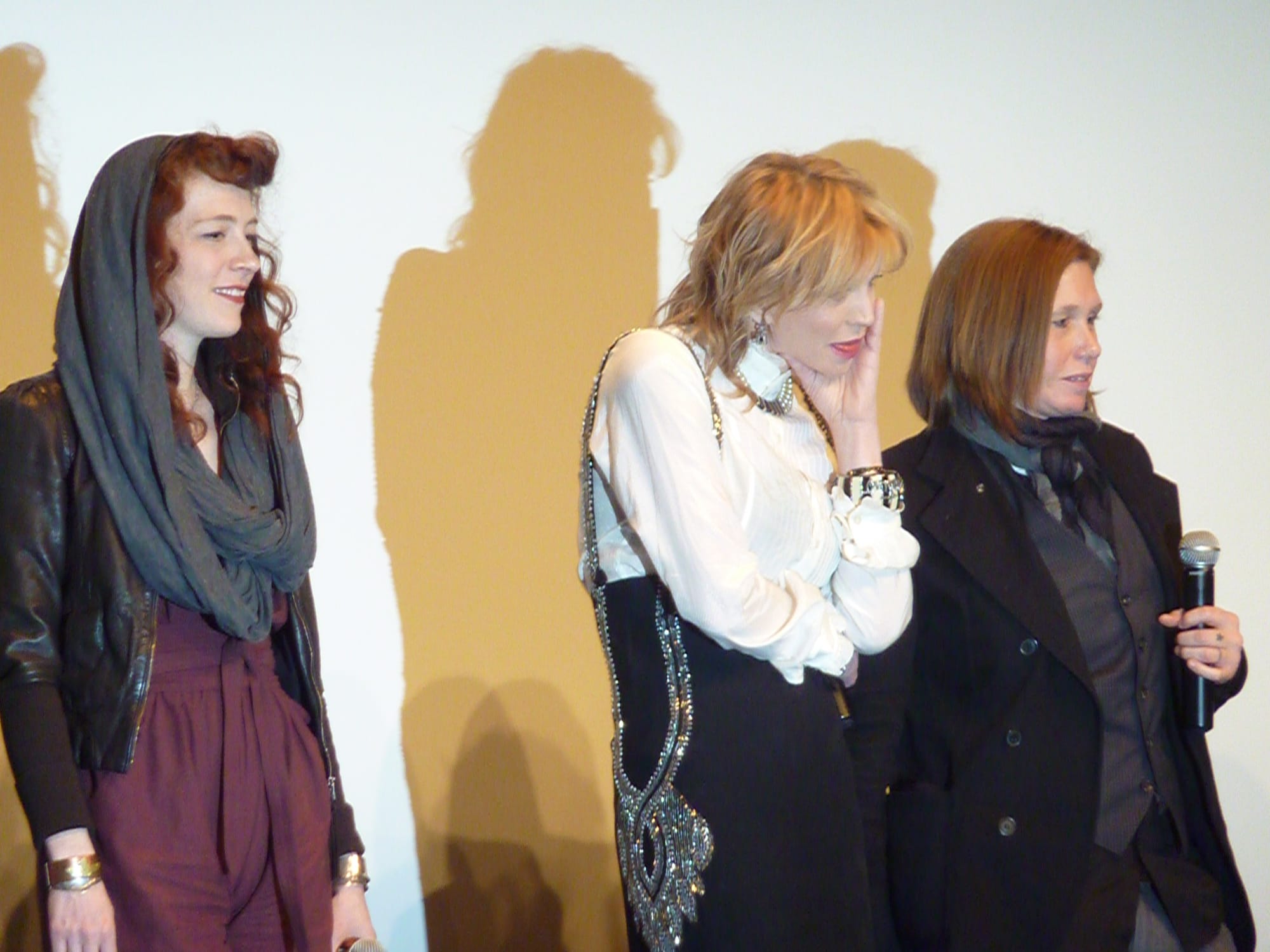
While this is Auf der Maur’s story without question, one of the biggest takeaways for me was the firsthand evidence of how underappreciated, over-hated, and genuinely misunderstood Love’s entire place in the cultural spotlight was. But, most powerfully, Auf der Maur carefully details how she was able to navigate it all without fear and without ever checking out completely. Even during her darkest and messiest moments, she persevered. While her legacy will likely never become sanitized or exist without controversy, I do believe that time will be much kinder to her than the industry and, by extension, the world was. Courtney Love never sought to hide from the friction she experienced. If anything, she thrived on it. And in that, having people as grounded as Auf der Maur was critical to her survival. Their bond solidified quickly, and it's readily apparent that Love craved the balance offered by Auf der Maur’s caring and deep nature.
There is a great deal of intimate, poetic, and reflective storytelling to be found throughout this memoir. It would be fruitless for me to try to condense the sheer volume of noteworthy artists and figures who came in and out of Auf der Maur’s life that decade. But what I can unequivocally say is that if you love music, music history, and support the pioneering women who fearlessly cleared the path for those who would follow, then this is the book for you. If you want to hear a story of whimsical love and finding oneself, this is the book for you. If you ever wondered what it was like to be a rock star and then leave it behind in the name of peace and fulfillment, this is the book for you.
I turned the last page and closed my copy of Even the Good Girls Will Cry with a deep sense of satisfaction. But, most importantly, I felt a sense of gratitude, inspiration, and hope. Gratitude for the women like Auf der Maur, her mother, Love, my own mother, and grandmother… and the countless others who still inspire. Inspiration to not be afraid to commit to artistry and let the wind carry me through the beauty and chaos of life. And hope that in the modern era of chronically online insanity, we can collectively find the world-saving powers of true artistry and community once more.
It’s a tall order, maybe. But so long as we remain truthful, bold, expressive, and passionate, it can be done.
So thanks for the inspiration, Melissa. I think I’ll go be my own “spiritual fucking cowboy” now…


Comments