

One of the unsung heroes of modern rap, Vince Staples, has been consistently top-tier. Lyrically, musically, politically, socially, vibes, production, collaborations, features, etc., etc., etc… The man has always been at the top of his game, having come out of the gates swinging with his debut double-album, Summertime ‘06, and then continuing to climb to new artistic heights from there. Authentically West Coast, the Long Beach rapper has forged a career that evolves and experiments with each subsequent release while still remaining distinctly “Vince.” His influences growing up were heavily defined by the Long Beach subculture and include the likes of Bradley Nowell more than Tupac. On Cry Baby, Staples creates a musical landscape that strays into alt-rock territory. While I think the punk declarations by various publications are maybe a little overblown, the sound and spirit of the album are absolutely in line with that ethos.
No one does it quite like Vince. From a summertime party bop that might go a little deeper than you notice on first listen to an existential ponderance of life set to a catchy beat, Staples has always been able to pivot and weave between a wide selection of topics and commentary intertwined with poignant storytelling and top-tier, dynamic production.
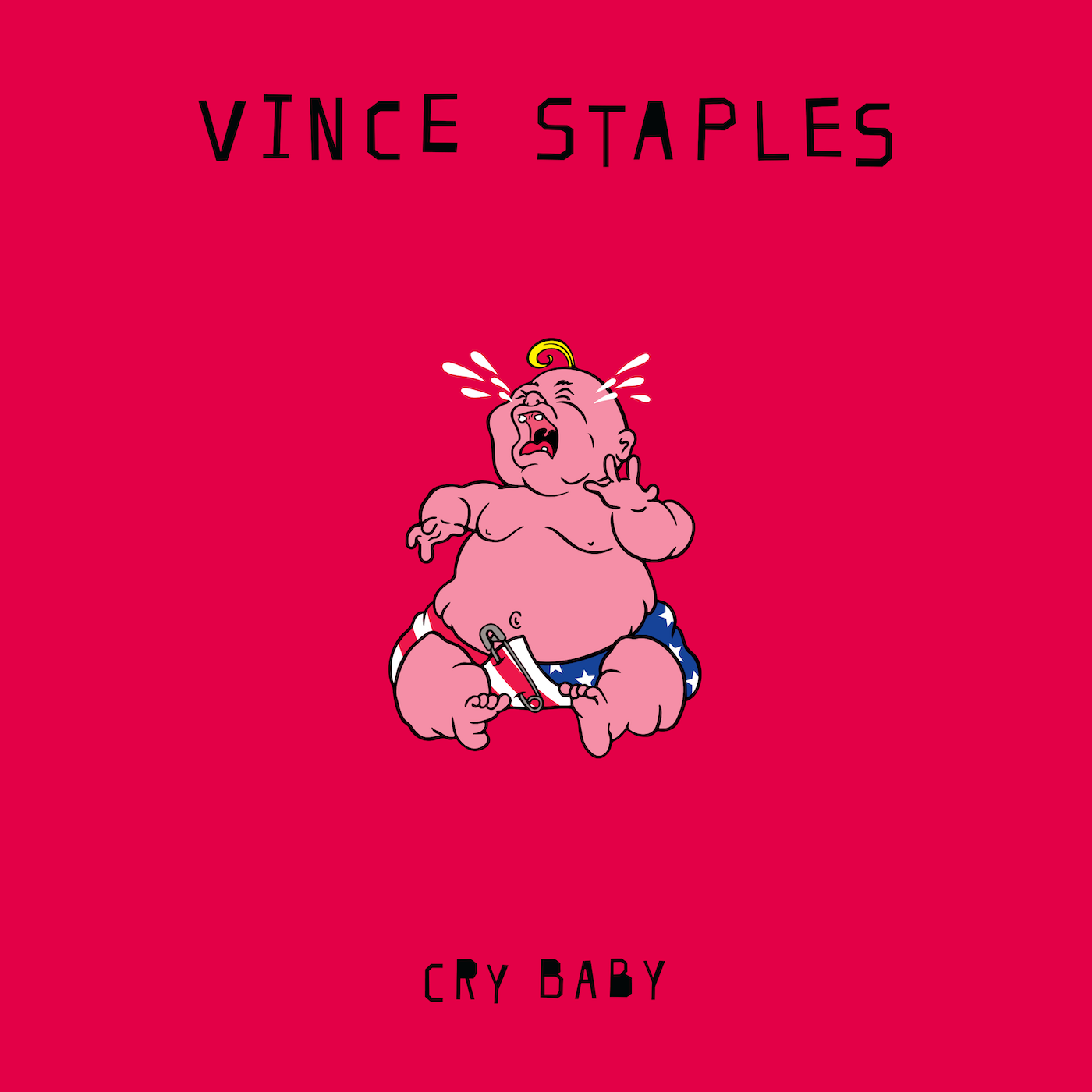
With Cry Baby, Staples adds an emphasis on live instrumentation to evoke the aforementioned alt-rock soundscapes, as well as a heavier emphasis on the current sociopolitical landscape. I’ll leave you to infer what you want from the album’s cover, but he’s not exactly shy about what he’s trying to say. While not quite Rage Against the Machine, he takes a bigger leap into observing the world as it is, why it sucks, and how it all makes him feel.
Cry Baby is rooted in the language and sentiment of impending revolution, or at least the need for it. As he says on lead single “White Flag,” “I don’t wanna fight no more.” But that exhaustion he’s experiencing isn’t from a standpoint of defeatism. It’s an expression of being disillusioned by the power structures that continue to perpetuate a social landscape of injustice, bigotry, division, and batshit insanity. The album persists in calling out the system as it exists, specifically, how it’s failed so many disenfranchised segments of the population of this country and, even more urgently, how action is needed now, before we hit that sociopolitical event horizon and point-of-no-return. The system is fragile, nonsensical, and highly destructive, favoring the few over the many. And as a young black American, Staples is all too familiar with the struggle. On this album, he explores both his understanding of it and how it continues to affect him and his fellow Black Americans.
On “The Running Man,” Staples opens with the lines:
'Bout time for a revolution
Dark times for the melanated
One time done hit the block, like clockwork
Time for an execution
He isn’t the type to stay silent or take the “both sides bad” easy way out. Historically, he’s remained consistent in expressing the reality of social ills, emphasizing systemic struggles accounting for race, class, capitalism, and the wealth gap. His response, both lyrically and in his personal life, has been to emphasize the importance of community. He doesn’t shy away from the gross oversimplification of today’s partisan-political-sports-teams that perpetuates identity politics. While there are clear, easily-made distinctions in morals, principles, and values, the reality is that the entire system is fundamentally broken. Calling out bigotry and disenfranchisement becomes meaningless when nothing changes. And throughout Cry Baby, Staples is pushing for that change.
On opening track “Blackberry Marmalade,” he wryly observes:
Anti-establishment, crackers on that shadiness (You know it)
Crackers watched me work and break my back and said they gave me this (You know it)
Crackers tapped my pockets with taxes, said they made me rich (Yeah)
Cracker jacked the sound and soul, then boxed me in and shelved my shit, like Black men (Uh, uh)
Don't let 'em trouble you (Don't let it trouble you)
American front on you (It's gonna be okay)
I know it befuddle you
But don't let it get to you (Don't let it get to you)
Just know that they miserable (Know that they miserable)
And know that behind every smile
They thinkin' 'bout killin' you (Say it)
This verse is loaded: It’s a clear call-out of pseudo-revolutionary movements, extremism, the commodification of Black culture, and it ends with a final declaration that once you’ve been used and discarded, the ultimate goal is for them to kill you. Taken literally, it’s straight out of Jordan Peele’s Get Out. As a metaphor, it showcases how the power structure of white America is intended to retain dominance and only use Black artists as a means to make money, while ultimately not caring for the actual art or artists. They’re seen as disposable at best and targets at worst.
And that’s the point, isn’t it? The system we currently find ourselves a part of was designed to work for a specific group of people (AKA people that look like me: white/straight/male) while disenfranchising everyone else and “othering” them. Religion, of course, being one of the most oft-used tools of suppression, has a noticeable presence on this album. Staples himself is non-religious, but has consistently expressed his understanding of its appeal to those who find comfort in its principles and storytelling.
On “White Flag,” he acknowledges the paradox of his own success using divinity as the reasoning:
Sometimes love can turn to war
I've seen it all before, not far from par the course
Try not to get too lost
It ain't no coming back soon as your back against the wall
Light as a rock, rough as a hard place
Out of the box because of God's grace
It’s a perfect encapsulation of his thoughts on being able to sympathize with religious individuals. With this line, he’s able to attribute luck, fortune, and success that can feel unearned or provoke a sense of “survivor’s guilt” for him to something beyond human understanding. Or simply luck that feels divine. It can also be read as a sly critique of anyone achieving success immediately glorifying God, while the opposite is never true, i.e., casting blame for the ills of the world. An eternal, Theology 101 philosophical argument condensed and concisely conveyed here.
My point is this album has a lot to unpack, and there’s not a chance in hell I can do it after only a couple of days of listening.
So I think I’ll just move on to emphasizing how fucking rad this record is musically.
There’s a combination of factors that set this album apart from its closest contemporary releases. Vince Staples has always served to be observational. He has immense credibility in his worldview and the expression of it. He’s not filling tracks up with buzzwords and unsubtle, media-illiterate takes. He’s still poetic, driven, and artistically inspired. And in his marriage of artistry and message, Staples succeeds where so many others often stumble. But most importantly, he doesn’t neglect the medium of the messaging. The man has consistently created an exciting array of tracks across every subgenre within modern hip hop. And here, he takes an approach of alt-rock structuring, live instruments, carefully curated sampling, and a cohesive tightness. It’s ten tracks and 35 minutes of sonic excellence.
There’s not much more I can say without ruining the individual experience to be had with Cry Baby. An easy contender for ‘Album of the Year,’ I implore you to listen. Because, even though it deals with some tense, heavy topics (as I’d argue most good music tends to), the experience is far from joyless.
Vince is an artist above all else, and, in the name of artistic musical excellence, he delivers in spades with Cry Baby. It is a bangers-only soundtrack to the revolution.
Cry Baby Tracklist:
1. Blackberry Marmalade
2. Go! Go! Gorilla
3. White Flag
4. The Running Man
5. TV Guide
6. The Big Bad Wolf
7. Only In America
8. Do You Know The Devil
9. Cotton
10. 7 In The Morning


Comments